Posts

Showing posts with the label Multi-curve framework

Published!

Image
My " Interest Rate Modelling in the Multi-curve Framework " book has finally been published! It took quite some time between finishing the writing in the first half of 2025 and the actual physical availability. Hopefully some of you will find some interest in the result. Training based on the book’s content will be proposed. It can be as in-house or public workshops. One of the public workshops is planned for 17 and 18 December. Don’t hesitate to contact me if you are interested. ISBN-13: 978-3-032-02684-2 Related posts: Multi-curve framework book: new edition in progress Multi-curve book's cover Multi-curve book's cover (2) Multi-curve book: About the Book Multi-curve framework book new edition: endorsement by Andrea Pallavicini Multi-curve framework book new edition: endorsement by Marco Bianchetti Multi-curve framework book new edition: endorsement by Damiano Brigo Book publication soon!

Book publication soon!

After more than 6 months of delay, it appears that the editor finally managed to provide clean proofs for the second edition of my book " Interest Rate Modelling in the Multi-curve Framework: Foundations, Evolution, Transition, and Implementation ". The manuscript was finalised in May ... 2025, we can now hope for a publication in July 2026. As soon as physical copies are available I will post a message on this blog! Thanks for you patience.

Hallucination?

I’m not a fan of the so-called Artificial Intelligence, which is to my opinion at this stage more like “automated plagiarism” than actual intelligence. Nevertheless I use it from time to time, with limited success. I could not resist to ask the following question: What is the best book to learn about the multi-curve framework? The answer is: The best book to learn about the multi-curve framework is generally considered to be Interest Rate Modelling in the Multi-Curve Framework: Foundations, Evolution and Implementation by Marc Henrard. This book is written by one of the "founding fathers" of the framework and is specifically tailored for both academics and practitioners. Why this book is recommended Comprehensive Coverage: The book provides a detailed analysis of the framework's foundations, its evolution post-financial crisis (2007-2013), and implementation. Practical Focus: It describes the issues and provides examples of coherent, production-grade li...

Multi-curve framework book new edition: endorsement by Andrea Pallavicini

Different experts in interest rate modelling were kind enough to write an endorsement for the multi-curve new edition book. Part of them are displayed on the back-cover (there is not enough space to display the full texts there). I will publish on this blog the longer versions of them between now the actual book's publication in November December. A decade ago, this book did not just introduce the essential multi-curve framework; it also laid its foundations with rigorous clarity, recognizing the pitfalls of simply adapting old "one-curve" approaches. Now, in its vital second edition, the author delivers an even more indispensable resource, profoundly addressing the market shifts that have redefined interest rate modeling. This edition is a direct response to critical changes like BCBS-IOSCO margin requirements and, most importantly, the end of LIBOR and the benchmark transition. The book's strength lies in its axiomatic approach, providing solid proofs and clea...

Negative Swap / Government Spread: A SOFR definition impact

Image
Negative government bond spreads have been a puzzle for some people for a long time. The question has been stated in some places as `` How can the banks borrow at a lower rate than the government? ''. I have already partially given my point of view about that issue in a blog 10 years ago . That was in the context of the LIBOR swaps, but it is still true in the SOFR case. Now I want to add some technical details for the SOFR OIS case. To some extent, I claim that the swap spread have to be negative! SOFR-OIS swap / government spreads In this analysis, I'm using the results of the multi-curve framework in a loose sense. I'm using expected values, without clarifying in which measure they are and extended the results to government bonds. The goal is to indicate that the ISDA definition of SOFR (introduced below) used in swaps may have an hidden impact on swap spreads. For this simplified approach, I'm presenting the impact only for zero-coupon bonds. The notation ...

Multi-curve framework book new edition: endorsement by Damiano Brigo

Different experts in interest rate modelling were kind enough to write an endorsement for the multi-curve new edition book. Part of them are displayed on the back-cover (there is not enough space to display the full texts there). I will publish on this blog the longer versions of them between now the actual book's publication in November. Marc Henrard has written a much needed second edition of his successful and popular multi-curve book. After a number of events, including the so-called LIBOR end hit the markets, and new types of contracts with new types of rates have appeared, together with some instances of survival of the old rates, a book like this has been much needed for the quant community and beyond. I will personally recommend this book to my MSc students who need to navigate the nuance of current interest rate markets. Marc has done a massive work of absorbing the changes introduced both by public institutions and the quant community in a coherent narrative. The boo...

Multi-curve framework book new edition: endorsement by Marco Bianchetti

Different experts in interest rate modelling were kind enough to write an endorsement for the multi-curve new edition book. Part of them are displayed on the back-cover (there is not enough space to display the full texts there). I will publish on this blog the longer versions of them between now the actual book's publication in November. This is the book I would have loved to write, but now that I have it in front of me, I realize I would not have matched Marc Henrard's excellence. All the essential aspects needed to understand modern interest rate modelling theory, as well as to apply it in everyday financial practice, are clearly explained with a rigorous yet practical approach. Definitely, it is one of the books that every practitioner of quantitative finance should read and keep at hand. Marco Bianchetti Head of Market and Counterparty Risk IMA Methodologies, Market and Financial Risk Management, Intesa Sanpaolo, Milan Adjunct Professor of Advanced Interest Rate...

Multi-curve book: About the Book

The multi-curve book continue its march to production. The final proofs are expected for the end of October for a book publication in November. Find below the book's synopsis. About the Book A new standard in interest rate modelling, called the multi-curve framework, emerged after the financial crisis. The framework covers two important market features: the collateralization of derivative trades and the spread between different rate benchmarks. This book starts from the collateral mechanisms and builds the full framework from the foundations through all the technical and financial details. It kicks off with the collateral discounting in all its variants: domestic cash, foreign cash, or other assets and then introduces the different benchmarks and their associated spreads. Following the discontinuation of certain benchmarks, part of the book is dedicated to the transition and the emergence of the overnight benchmark dominance in certain currencies. Based on the theoretical fram...

Multi-curve book's cover (2)

Image
The book's new edition continue its progres. After the picture used for the book's cover background, I can propose a draft view of the cover page. More details will be posted soon. Related posts: Multi-curve framework book: new edition in progress Multi-curve book's cover

Multi-curve book's cover

Image
The book's new edition is progressing. In can propose a preview of the book's cover background. It is based on the same picture as the one that has been in the this blog's header for some time.  The picture was taken in 2019 in New-York at the Oculus. New York is certainly an important financial center, it headquarters the Federal Reserve Bank of New York which publishes SOFR , probably nowadays the most important interest rate benchmarks and one mentioned multiple times in the book. The picture also represents figuratively multiple curves, more or less related, with a spread between them. Related post: Multi-curve framework book: new edition in progress

New edition with the editor

It took me a little bit longer than expected, but the new edition of “ The multi-curve framework ” book is now with the editor. I will provide more details on the advancement of the book's physical production when I receive them.

Multi-curve framework book: new edition in progress

Image
Subject: Interest Rate Modelling in the Multi-curve Framework: Foundations, Evolution, and Implementation It has been more than 10 years since I wrote the first edition of the multi-curve framework book. What happened in those 10 years? Why did it take me so long to start a new version? It took me roughly 10 years to write the first edition. The reason it took so long at that time, was that I did not know that I was writing it! I thought I was writing a couple of pages on an obscured and theoretical idea that there was not a `` one curve to rule them all '' but multiple curves. It turned out that it became the actual practice for very clear and important reasons. That was the excuse for the first edition, what is the excuse for the second edition? Since the first edition, many things happen, in particular: March 2015: BCBS - IOSCO: margin requirements for non-centrally cleared derivatives and mandatory variation margin July 2017: The future of LIBOR -- actually it...

X dominates the world

Image
For more than a decade, collateral discounting as been the de facto standard for derivative valuation. The central technical concept of this approach is the expectation under a currency — but not collateral mechanism — dependent measure. That measure is denoted in part of the literature. This is the notation I used in my Multi-Curve Framework with Collateral paper in 2023. This is the paper that developed the details of the “collateral square” valuation, when the collateral is is an asset that can itself be used into a repo to obtain cash. The generic formula in that latter case is (originally described in formula 13 in the above paper). The measure X appears in the expectation and is central to the approach, based on replication. It mathematics, it is traditional to add some marker (like a tilde or a bar) on some symbols to indicate another object similar or generated from the first one. One symbol that I like is the "check", which I called when I was lecturing in fren...

Convexity adjustment and discounting transition

The collateral transition from EFFR to SOFR as planned by LCH and CME in October 2020 generates an exotic convexity adjustment on USD-LIBOR payments with respect to the absence of collateral transition. This convexity adjustment is already incorporated in the cleared swap pricing. This adjustment leads to many questions. Some of them are What inverse convexity should be introduced to price OTC bilateral LIBOR swaps from cleared LIBOR swaps? Why was this adjustment not described by CCPs in their transition documents and no compensation for it was proposed? What is the order of magnitude of the convexity adjustment? In some sense, the third question may contain an answer for the first two. If the order of magnitude is negligible in practice, the answer to the first two question probably is: we don't care! I have submitted a paper proposing a (relatively simple) theoretical computation of the convexity adjustment and an estimate of the order of magnitude. The results indicate that the...

CCPs and ESTR clearing

CCPs have announced their plans regarding ESTR swap clearing. Some plans are described in a Risk.Net article titled " LCH sets €STR swap clearing launch date " (subscription required). Some of the claims there exhort me to react: 1. On the valuation and margining side, the fixed 8.5 basis point spread between Eonia and €STR means that we think it’s possible to use Eonia as a proxy for €STR as a risk factor. Whitehurst says. For the valuation, I agree: in October, EONIA will be equal to ESTR+8.5bps, so you can convert from one to the other. For the margin side (initial margin), it seems that they use logic in the wrong direction. You can use ESTR history (that does not exists yet) to predict the future of EONIA (that will soon stop to exists but in the mean time is related to ESTR). You cannot use the EONIA history (that was not linked to ESTR) to predict the future of ESTR (that will start to exists in October). I don't say that it is ...

Thanks for reading!

One of my original papers on the multi-curve framework has now attracted more than 4,000 downloads on SSRN. The first paper was published in July 2007, before the start of the crisis and was titled The Irony in the Derivatives Discounting . The second one, posted shortly after the crisis, was naturally called The Irony in the Derivatives Discounting Part II: The Crisis . My papers posted on preprint servers (RePEc and SSRN) have now attracted more that 50,000 downloads (and my multi-curve blog that you are reading now, more than 86,000 visits). Thanks for reading my Irony !

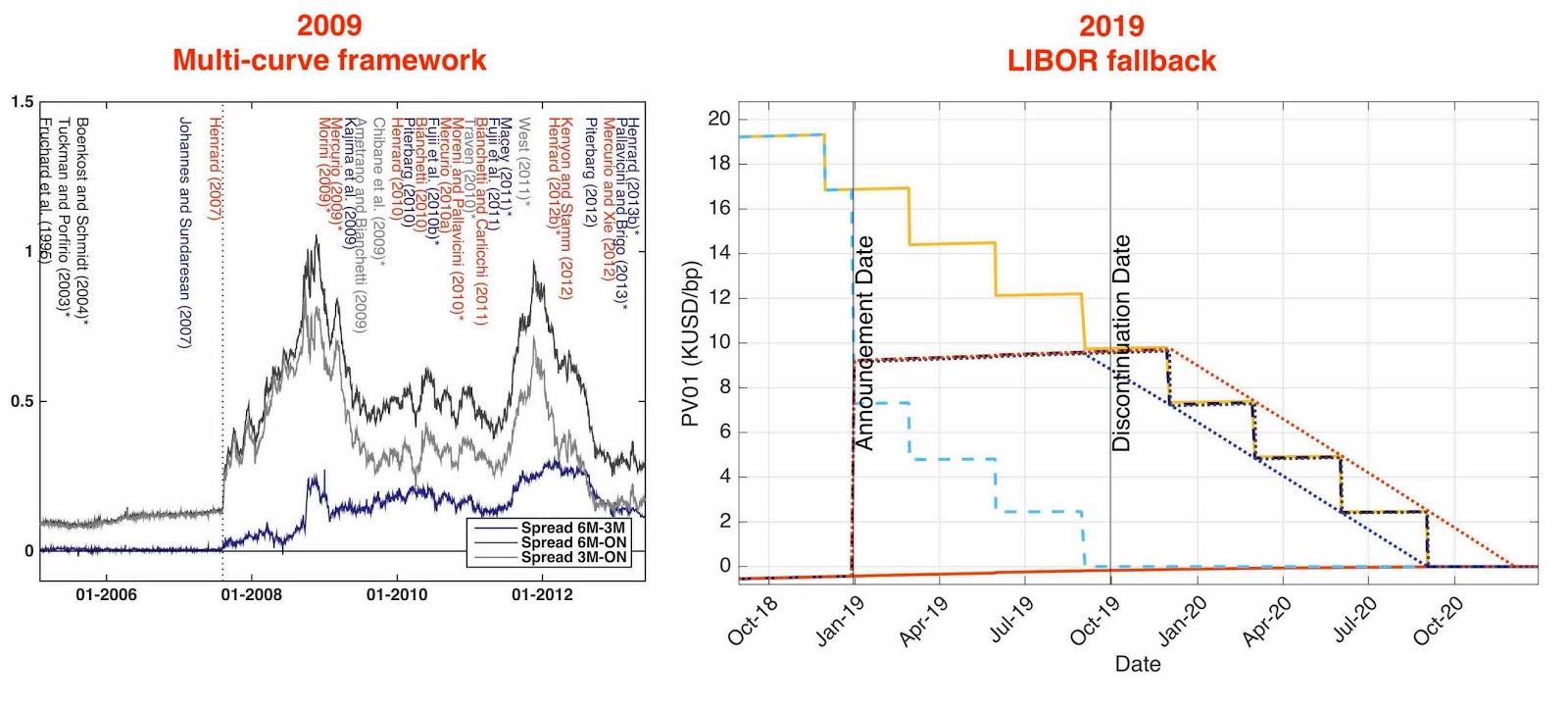
The 10 years challenge: Multi-curve

Image
Question: Does the LIBOR transition means no more multi-curve framework (and I have lost 10 year working on it?) My answer: I don't think so. It is a maybe Double or Quit but the multi-curve is here to stay, even if in a different form.

Fallback, cash flows and OIS discounting

Image
In the IBOR fallback issue, there are different criteria we would like to impose in order to obtain a clean fallback. Among those criteria are the absence of value transfer and the coherence (IBOR is IBOR). The fallback procedures proposed in ISDA consultation rely on the replacement of each IBOR fixing by an RFR-linked rate plus an adjustment spread. The existence of CCP basis (and bilateral to CCP basis) which is potentially different between LIBOR products and OIS products leads to the following paradox: if we want to achieve the absence of value transfer, we need to select an adjustment spread that is different for the same IBOR and RFR depending on the clearing location, which is a violation of the coherence criterion. If we keep coherence, we have the same spread and consequently there is a value transfer. Where is the paradox coming from? I would say that it is coming from a misunderstanding of the OIS discounting formula. The formula is written as (see Formula 8.6, based ...

SOFR: multiple basis

A couple of weeks ago, CME announced that they cleared their first SOFR-linked swaps . The first trades where cleared by BNP Paribas, Credit Suisse, J.P. Morgan, Morgan Stanley and NatWest Markets. The total notional was USD 200 million without details on the type of swaps or their maturity. The main difference between the SOFR-linked swaps cleared at LCH and those cleared at CME is the Price Alignment Interest (PAI)/collateral rate. For LCH it is EFFR while for CME it is the SOFR itself. Both CCPs accept OIS (Fixed v SOFR) and basis (LIBOR v SOFR and EFFR v SOFR). Also LIBOR, EFFR and SOFR futures are traded. This means that now we have the full spectrum of legs types, PAI and adjustments: LIBOR leg with EFFR collateral (LCH, CME, bilateral) OIS-EFFR leg with EFFR collateral (LCH, CME, bilateral) OIS-SOFR leg with EFFR collateral (LCH, bilateral?) LIBOR leg with SOFR collateral (CME in basis swaps) OIS-EFFR leg with SOFR collateral (CME in basis swaps) OIS-SOFR leg w...

ICE Term Risk Free Rates

I will start with my usual rant about " risk free ". SONIA is based on unsecured transaction and is credit risky. Not risk free on the credit side. A term rate is, as its name says, fixed for a term and the value of a term instrument changes when the market changes during that term. Not risk free on the market side. I cannot understand why this incorrect terminology of " risk free " is so widely used while plenty of correct and more meaningful terminology are available: collateralised rate , overnight-linked rate , overnight-indexed rate , derivative term rate , alternative rate (I don't like alternative rate too much either, it opposes the current name to a previous approach instead of positively describing the present, but it is better than risk free), IBA (ICE (InterContinental Exchange) Benchmark Administration; I like those acronyms based on acronyms) is launching a "ICE term RFR" . The term rate is based on futures prices. The first version ...