Posts

Showing posts with the label Market Infrastructure

Negative Swap / Government Spread: A SOFR definition impact

Image
Negative government bond spreads have been a puzzle for some people for a long time. The question has been stated in some places as `` How can the banks borrow at a lower rate than the government? ''. I have already partially given my point of view about that issue in a blog 10 years ago . That was in the context of the LIBOR swaps, but it is still true in the SOFR case. Now I want to add some technical details for the SOFR OIS case. To some extent, I claim that the swap spread have to be negative! SOFR-OIS swap / government spreads In this analysis, I'm using the results of the multi-curve framework in a loose sense. I'm using expected values, without clarifying in which measure they are and extended the results to government bonds. The goal is to indicate that the ISDA definition of SOFR (introduced below) used in swaps may have an hidden impact on swap spreads. For this simplified approach, I'm presenting the impact only for zero-coupon bonds. The notation ...

Open letter to Ursula VON DER LEYEN in relation to REGULATIONS on the designation of a statutory replacement for certain settings of CHF LIBOR

Open letter to Ursula VON DER LEYEN in relation to REGULATIONS COMMISSION IMPLEMENTING REGULATION (EU) 2021/1847 of 14 October 2021 on the designation of a statutory replacement for certain settings of CHF LIBOR Dear Ursula, I read with interest your REGULATION (EU) 2021/1847. If you don't mind, I would have a couple of simple questions regarding the text. I'm certain the numerous consultations you indicate you have done have already answered those questions, so it should just take you a couple of minutes to answer them. Ambiguous definitions (rate) The text indicates 1-month CHF LIBOR is replaced by 1-month SARON compound Rate, as observed over the 1 month period preceding the interest period; What is the meaning of " 1 month period preceding ". From my experience, this is not a trivial question in finance. The first ISDA consultation, published in July 2018, had a similar issue. It indicated " observed over the relevant IBOR tenor and compounded daily dur...

Signing the LIBOR fallback protocol: a cautionary tale (again)

Image
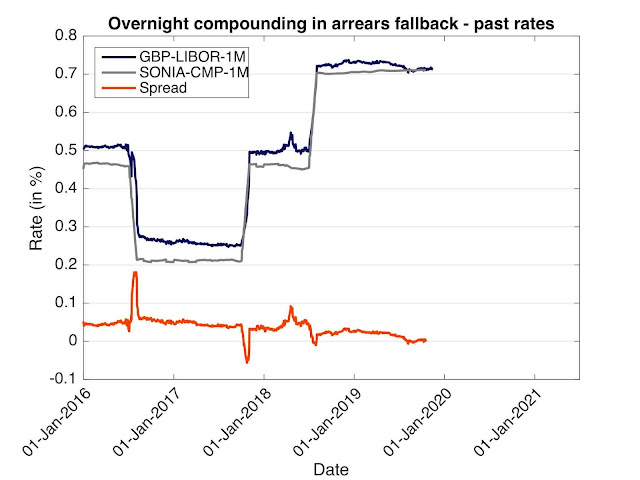
We are approaching the publication date for the new ISDA definition related to the IBOR fallback and the related protocole. Questions related to their impact are becoming more and more urgent. I was interviewed once more by Risk about those issues. Some quotes will probably appear in a Risk article in the coming days or weeks. Here is a more extensive summary of my comments. I'm starting with a graph without comment. If the meaning of the graph and its relevance to the protocol signature is not obvious to you, I would advise not signing the protocol! See my first cautionary tale about signing the LIBOR fallback protocol . A robust fallback is important, the fallback embedded in the current ISDA definitions is not robust. Something need to be done about it, preferably before January 2022. Where I disagree with the marketing barrage in favor of the ISDA protocol that we have seen recently is that the ISDA proposed fallback is the only one that is possible. I even disagree ...

Where is ESTR? (3)

Image
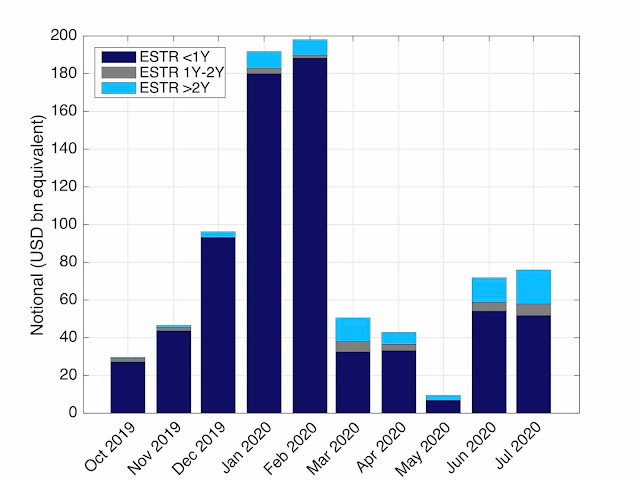
This is a follow up on previous post on Where is ESTR? and Where is ESTR? (2) In the mean time, the main CCPs have switch their PAI to ESTR in EUR and it should be the standard now. The July data includes one week in the new regime. What do we see in the LCH-cleared OTC data? Almost nothing! The monthly volume for ESTR OIS was 76 bn (USD equivalent), just  above 1/3 of what is was in January and February (see graph below). Not a very positive trend. Figure 1: Monthly ESTR volume at LCH. This means a total volume for ESTR OIS of 640 bn since the start of the year. This is in contrast with the 53 trn in all OIS (EONIA and ESTR). ESTR-linked products are only 1.2% of all overnight-linked products. The ISDA SwapsInfo weekly provides different figures, which are related to trade disclosed under US regulation only. In the last week, there were 20 new trades, this is around 20% of the number of trades since the beginning of the year. A big relative increase, but an increase from a...

Discounting big bang: CME auction process

CME has proposed a couple of webinar related to the collateral and discounting big bang planned for October 2020 . The general process is based on cash and discounting risk compensation. The discounting risk compensation involves the booking of EFFR-SOFR basis swaps in the accounts of all participants (members and clients). They clients can sell those basis swaps through an auction process (at their risk and cost). In this post, I look at some elements related to the auction as presented by CME in its recent webinars. Some elements of the discounting risk compensation Cash and discounting risk compensation based on the position and market levels as estimated by CME on Friday 16 October (EOD) Basis swaps obtained using DV01 of the portfolio for 6 tenors (2Y, 5Y, 10Y, 15Y, 20Y, 30Y), 6 trades are booked in all accounts with clearing date Monday 19 October Basis swap restore approximate pre-transition DV01. There are 3 sensitivity types (EFFR, SOFR, LIBOR). At most one can be restored. To...

Fact-check on ISDA fallback fact sheet

ISDA has published yesterday a fact sheet called " Understanding IBOR Benchmark Fallbacks ". I did my personal fact-check about the fact sheet. Q: " What is benchmark fallback? " A: " benchmark becomes unavailable ". True. " FCA has stated that it will not compel banks to make LIBOR submission after the end of 2021 ." True, but almost irrelevant . This power to compel banks is very new (EU BMR, 2016), has never been used and has never been a factor since 1986. The only thing that FCA is saying is that it will not use its newly acquired EU regulation based power that has never been used in history, nothing more, nothing less. " In was determined that the fallback will the adjusted versions of the RFR. " Partially true. True : It has been determined by ISDA (and others) that this will be the only fallback appearing in ISDA definition. Partial : But other market players have decided/determined that they will use other fallbacks....

Would you pay 1,000,000,000 USD for public information?

Image
The IBOR fallback has been a hot topic over the last years. Will it soon also be an expensive topic? Don't worry, dear Reader, I do not plan to charge for my blogs ( multi-curve and muRisQ ). You will continue to get the most accurate and independent information available at the best price possible (0 USD). You may even find from time to time some open source code. No, my question is related to the adjusted RFRs and adjustment spreads. According to a recently published Bloomberg FAQ , " Yes, a license will be required from Bloomberg for usage of the ISDA fallback rates. " Those rates are based on publicly available information. In USD, this is based on SOFR , available on the Federal Bank of New York website and some past LIBOR rates. From those public rate, a public formula of interest rate composition, which has been public for more than 500 years (see for example Pratica della mercatura published around 1340), is used. I have myself published more recently (onl...

CCP Discounting big bang: delaying or not?

In a recent opinion , following to the QuantSummit panel where I was asked a similar question, I indicated that one of the first element I would like to see delayed due to the current crisis and the related emergencies is the CCP discounting big bang. First, the big bang was not necessary. The original idea, as described in the ARRC paced transition plan, was to have a period with two parallel PAI world and transfer smoothly and over time between them. Later it was decided on the EUR and USD sides to skipped the "paced" part and do a big bang, at least at the CCP level. The big bang make the transition easier for CCPs. One day they have one approach, the next day (actually 3 days later, as this is done on a week-end) they have another approach. At any moment, they have to deal with only one discounting curve. This is not the case for the users. They have the cleared trade to deal with, so the complexity for them is at least as high than for the CCPs, but also numerous bil...

Libor transition plans: delaying CCP discounting big-bang?

At a Quant Summit's panel last week, I was asked about the impact of Corona virus on LIBOR transition. Some of my comments were reported in Risk in the article Pandemic threatens Libor transition plans . I'm not a medical doctor (merely a doctor in mathematics) and I have no relevant advice on the pandemic itself. But if there are events that require special efforts and staff involvement (and the current situation certainly fit this description), is there some planned changes in the market that could be delayed? My immediate answer at the panel was UMR category 5 and LIBOR cessation. UMR is a long term project; the exact date is not important, what is important is the long term impact in term of counterparty risk in derivative; the approach selected can be agreed with or not, but certainly the impact is long term. The preparation impact is huge, but the financial impact on the implementation date will be 0. Delaying its start date by some months, or at least d...

Compensation (and lack thereof): swaptions, protocol and swaps

Today is February 29th. I couldn't resits publishing something, at least for the date! Yesterday a new article related to rate transition hit Risk.Net. This time about the swaption compensation (subscription required). This is what I said about this compensation a week or so ago: "Personally I don’t believe that a market-wide compensation will be found, for the same reason that I believe that ISDA fallback protocol will not be generalised. Those value transfers create winners and losers; losers will sign, winners will not. If I know that I would have to compensate you for some swaptions and I have no legal obligation to do so, why would I even discuss a mechanism to do so?" The only argument for the compensation is some kind of peer pressure and credibility of the transition process. This roughly the summary of the Risk article. Let me compare this with my recent favorite subject: Cost of signing the LIBOR fallback protocol . In the swaption case, there is a ful...

Pre-cessation trigger consultation: here we go again!

Pre-cessation trigger consultation: here we go again! ISDA has launched yesterday a second consultation on pre-cessation fallbacks . The first consultation did not provide the results the Power from Above wanted, so here we go again. My answer is below. It is a summary of arguments I have made in previous article and blogs. I may improve the wording before sending it to ISDA. If I do so, I will update this blog accordingly. ISDA Question (summary): Should ISDA publish a Supplement to the 2006 ISDA Definitions so that the Rate Options for LIBOR all contain fallbacks that would apply upon the first to occur of (i) a permanent cessation trigger or (ii) a ‘non-representativeness’ pre-cessation trigger? Answer: NO Additional explanations: In the current master agreements, the only event that leads to a fallback is the non-publication of the rate, there is no notion of announcement date and even less pre-cessation trigger . A pre-cessation trigger forces extra complexity and...

SOFR Averages publication by the Fed: what for?

The Federal Reserve Bank of New York has requested comments on its Proposed Publication of SOFR Averages and a SOFR Index. The proposal and the request for comments are available on their website at https://www.newyorkfed.org/markets/opolicy/operating_policy_191104 . I commented on the proposal as can be seen on my post: Comment on a Proposed Publication of SOFR Averages and a SOFR Index . The NY Fed has decided, against my advice, to go forward with the publication of those averages. The statement has been posted on 12 February on their website: Statement Regarding Publication of SOFR Averages and a SOFR Index . The page contains a link to the answers received (including mine). The main reason for my advice to not publish such average was that it is, to my opinion, useless and creates confusion . The publication of the statement and the reading of some of the comments reinforce my opinion. Nowhere in the statement or in the comments have I seen one single proposal on how to use those...

Making money on LIBOR fallback (one year later)

Image
At the end of November 2018, I took a GBP (paper) position on my view that LIBOR fallback approach will allow better informed participants to make money (transfer value from) the end-users. I have reported on a regular basis about that position in the first six months (see list of episode at the post bottom). One year later, what happen to that view and to my position? I'm happy to report that Saint Nicolas brought me a very nice present ( Saint Nicolas is an important day in Belgium for good kids like me ;)). On 29 November 2018, I wrote The horizon for my position is 29-Nov-2019. Target profit is 5bps x ~2000 GBP/bps = ~10,000 GBP. I cut the position on the earliest of when the market has reached 8.5 bps or on 29-Nov-2019. I'm also expecting a little bit of carry as the current level of realised spread (1 to 3 bps) is below the market basis spread. Where do I stand today? According to my figures, in term of spread convergence, the spread has decrease by 4.5 basis poi...

The Brattle Group report on ISDA consultation: manipulation, false claims and lack of attribution.

I finally found the answers to the second ISDA consultation on IBOR fallback. It has been published on 19 September, but somehow you have to navigate through a layer of webpages to find it. It never appeared on the ISDA news. To my knowledge, the only link is on the last line of the announce of the consultation on final parameters. The direct link is https://www.isda.org/a/0LPTE/2019.09.18-Anonymized-ISDA-Supplemental-Consultation-Report.pdf The report contains manipulation of the results, false claims, violate standard academic copyright fair use by not attributing to the authors in a recognizable way. Manipulation 21. If the respondents’ ranking preferences to the 2018 Consultation were such that the compounded setting in arrears rate with historical mean/median approach was not the preferred combination (i.e., ranked second or lower), these respondents also were treated as answering “Yes” to Question No. 1 of the 2019 Supplemental Consultation as long as the respondents were ...

CCPs and ESTR clearing

CCPs have announced their plans regarding ESTR swap clearing. Some plans are described in a Risk.Net article titled " LCH sets €STR swap clearing launch date " (subscription required). Some of the claims there exhort me to react: 1. On the valuation and margining side, the fixed 8.5 basis point spread between Eonia and €STR means that we think it’s possible to use Eonia as a proxy for €STR as a risk factor. Whitehurst says. For the valuation, I agree: in October, EONIA will be equal to ESTR+8.5bps, so you can convert from one to the other. For the margin side (initial margin), it seems that they use logic in the wrong direction. You can use ESTR history (that does not exists yet) to predict the future of EONIA (that will soon stop to exists but in the mean time is related to ESTR). You cannot use the EONIA history (that was not linked to ESTR) to predict the future of ESTR (that will start to exists in October). I don't say that it is ...

The Fed Manipulated SOFR: the explanation (or not)

On 5 June, I published a post titled The Fed Manipulated SOFR . On 6 June, Risk.Net published an article titled A mystery: Why did the NY Fed use a survey to get SOFR? (subscription required). The Fed corporate communications has published a comment in Risk.Net that is supposed to be a rebuttal of those analysis . I was expecting rebuttal to be an argument on the quality of the market infrastructure put in place but I only heard " you cannot sue us for this issue ". It is true that the information on the production of SOFR is available in the Fed Website . But when the Risk.Net article was published, " A spokesperson for the New York Fed declined to comment. ", proof that it was not obvious even for the Fed; the "comment" referred above was published only on 18 July (more than one month and an half after the data); the CRO of a large bank when asked at an industry conferences said that he had no idea what happened. All those small items are evidences ...

Answer to the ISDA consultation on LIBOR fallback

My answer to the May 2019 ISDA consultation titled " Supplemental Consultation on Spread and Term Adjustments for Fallbacks in Derivatives Referencing USD LIBOR, CDOR and HIBOR and Certain Aspects of Fallbacks for Derivatives Referencing SOR " is now available. The document has been posted on SSRN with abstract ID 3415930 . It has not been "reviewed" yet but is already available. Comments are welcome! This answer is a follow-up on my answer to the July 2018 consultation on similar subjects .

LIBOR Fallback: is physical settlement an alternative? - Financial fiction

This could be classified as another episode of finance fiction! In this period of consultation related to the LIBOR fallback, I would like to describe an option which, to my knowledge, has not been mentioned yet: physical settlement. It is not new by itself and not a panacea for the fallback, but maybe it could have a couple of niche applications. To introduce that approach, I will take the case of caps/floors. If the fallback mechanism is based on compounding setting in arrears (1), as it is envisaged today, the cap/floor optionality changes dramatically. The current LIBOR caps are European options with expiry on the LIBOR fixing date; the post-fallback caps would become Asian options on the composition of overnight rate between the start accrual date and the end accrual date. This is a significant change in term of complexity and valuation mechanism. By luck, I wrote a formula that can price those instruments in a simple one-factor model more than 10 years ago in Henrard (2007)....

Ahead of the curve: how traders profited from Libor fallbacks

Interesting article in Risk.Net on "making money on LIBOR fallback". The title of this blog is the title of the Risk article published on 19 June 2019 (subscription required).  The title between inverted comma above is the title of my series of blogs on the same subject, the first of which was published on 30 November 2018 . The Risk article was in part inspired by my blogs, as you can see from the references to the figures I computed and the link to a recent muRisQ blog on the flatness of the GBP LIBOR-3M/SONIA curve .

Another incident with SOFR?

Image
A couple of weeks ago, I reported a manipulation of SOFR by the Fed . I have now to report an "incident" of unknown nature. The SOFR (and Effective Fed Fund Rate) data is not accessible anymore on the Fed website. But at the same time the data is still available in Bloomberg. Does that means that the results of public service work (the Statistics computed by the Fed) are not anymore a public good but can be accessed only through private services requiring a payment to a private company? It will be interesting to hear the explanation about this problem. I have not heard any explanation for  the "feed" problem of last month end. What actually happened? What would have been the SOFR fixing if the actual data had been used (and not a survey)? Edit Monday 24-Jun-2014: The page is up and running again. To my knowledge, there was no explanation why it was down yesterday. I will now be able to update my SOFR analysis...