Posts

Showing posts with the label CCP

SOFR first - two weeks on

Image
SOFR First started on 26 July. We now have two weeks of data. The result is somehow mixed. On the LCH front, the volume has decrease significantly last week with respect to the previous one (SOFR First initial week).  The volume is roughly the same as in end of May. On the ISDA figure side (from US regulatory figures), the absolute volume is slightly up but the proportion of SOFR with respect to LIBOR is down; it is below 8%. Still far away from SOFR First !

Monthly volume: SOFR, ESTR and SARON - July 2021

Image
No change on the EUR side at LCH. The volumes have not really moved in the last 5 months. I could not find volume figures on EUREX site (let me know if those figures are public somehow), so I don't know if a significant part of the volume is now trading at EUREX rather than at LCH. As mentioned last month, LCH has changed its reporting mechanism and does report only below 2Y numbers and does not split it any more in below 1Y and 1Y to 2Y. This is really unfortunate as the different OIS term rates are in discussion. Those term rates are based on liquid quotes for 1-month, 3-month and 6-month periods. It is of great importance to see the actual liquidity in those buckets. Removing the split is removing a very interesting piece of information in relation to the transition. On the CHF side, there was a significant increase over July. But it is only a small victory in the sense that it is only the first time that the volume is above the February 2020 volume (18 months ago). Good incr...

Monthly volume: SOFR, ESTR and SARON - June 2021

Image
This time I have also included the CHF figures. I will start there. The year-to-date (YTD) figures at LCH are LIBOR IRS at 1,670 bn and SARON OIS at 505 bn. LIBOR swaps represent still more than 75% of the notional (we have not included the FRA in the LIBOR part). Unfortunately PV01 figures are not available on LCH site, but one can guess that they would be worst for SARON. From the ISDA Clarus RFR adoption indicator (May 2021 as the June one is not available yet), it seems that globally the portion of SARON is below 15%. (*) Note that LCH has changed his volume report, with volume below 2Y as one bucket (instead of 2: <1Y and 1Y-2Y) and volume above 5Y as 3 buckets. In USD, the SOFR usage is increasing steadily but is still at relatively low levels. Over the month of June, 2,179 bn have been cleared at LCH; an increase of 23% form the previous record level in April. But the SOFR figures are still well below the LIBOR or even the Fed Funds levels. YTD, the LIBOR swap level at LCH...

Monthly volume for SOFR and ESTR: May

Image
Monthly review of ESTR and SOFR volumes. No progress in SOFR, no progress in ESTR. In May, the LCH SOFR volumes are barely above 70% of the April's ones. In volume, SOFR swaps are still below 3% of LIBOR swaps according to ISDA figures. With the decision by CCPs to steer away from ISDA's fallback and convert LIBOR swaps to OIS with spread, one could argue that LIBOR swaps and SOFR-OIS are the same products. Nevertheless given the uncertainty on the exact conversion mechanism and the non-fungibility due to spreads, I would be very reluctant to trade LIBOR swaps at this stage. Clearly the market majority disagrees with me and thus I'm wrong (but I don't know why)! EONIA is disappearing at the end of the year, in seven months, and the bulk of the OIS is still EONIA-linked.

Monthly volume for SOFR and ESTR: April

Image
Monthly review of ESTR and SOFR volumes. Decent progress in SOFR, no progress in ESTR. It seems that we can not get one month with increase in both. ESTR volumes decreasing with respect to March. EONIA is disappearing by 1 January 2022 with an unmanageable fallback process but the bulk of the EUR OIS volume is still in EONIA! The SOFR volume (ISDA figures based on US regulatory reporting) still indicates less than 3% SOFR/LIBOR ratio.

Monthly volume for SOFR and ESTR: March

Image
Monthly review of ESTR and SOFR volumes. Decent progress in ESTR, no progress in SOFR (opposite of last month). The ESTR swap volume over the month has jumped from 250 billions to 557 billions (USD equivalent). The SOFR volume is is slight decrease in March with respect to February. The monthly volume has decrease down to 1181 billions from 1310 billions. The ISDA figures (based on US regulatory reporting) are also stable. SOFR volumne is less than 2% of LIBOR volume.

CCP LIBOR cessation big bang: what about swaptions?

Over the last months there have been many discussion about the fallback (or more precisely the absence thereof) of cleared LIBOR swaps. The CCPs are planning another "big bang". Having been interested by astronomy since I was young, I thought there is only one "Big Bang" possible, but I'm not an expert. Maybe we should rename the LIBOR transition "bangs" as SME (Small and Medium-size Explosions). This new SME would cancel all existing LIBOR swaps before the cessation of LIBOR and create OISs with slightly modified payment dates. The solution is certainly one that I'm in favor of, having push for it by opposition to the ISDA Frankenstein-like fallback. I have suggested to my clients for many month to do something similar (see here and here ). The ISDA fallback is unmanageable from a market risk perspective as described in previous blogs: Fallback transformers: gaps and overlaps and here . Probably those public analysis have been used by CCPs to co...

Monthly volume for SOFR and ESTR

Image
Monthly review of ESTR and SOFR volumes. Decent progress in SOFR, no progress in ESTR The notional for ESTR is still below December. On the SOFR side the LCH volume is at record level. The ISDA figures show a small increase, but nothing really dramatic. In relative terms, SOFR is still only a couple of percent of LIBOR. Notional outstanding at LCH is LIBOR IRS: 59.2 trn, OIS: 16.4 trn and SOFR: 3.8 trn. Even for OIS, SOFR is still the minority of outstanding volume. Note that this means that there is 12.6 trn of Fed Fund OIS that are discounted at SOFR and hence need a "convexity adjustment" in their valuation and not straight forward use of Fed Fund pseudo-discount factors (see my paper Derivative Pricing with Two Collateral Rates (February 2021, preliminary version) for more details). For more details about the SOFR related volumes, see the Clarus blog: SOFR Futures and Swaps – Feb 2021 .

Another big bang: CCPs steers away from ISDA fallback

LCH has published a new circular related to the transformation of LIBOR related contracts at cessation . I commented earlier on the issues in my post Wow! - LCH plans Libor swap switch to RFRs and CME steers away from ISDA fallback . With the further document published by LCH, a further discussion on the subject appears timely. Before discussing the LCH solution, we should review why we are there. The need of a "solution" is because the fallback proposed by ISDA is ill-conceived from a risk management perspective. This is not a surprise. The different consultations and analysis have probably been done from a legal point of view but from the start the risk and valuation aspect has been neglected. I have been one of the first, but certainly not the only one, to point to those issues. My blog from 26 July 2018 ( Consultation on IBOR fallbacks: Question 1 ) already points at the issues that will lead to the need of a "solution" from LCH. After that original fallbac...

Where are ESTR and SOFR?

Image
Monthly review of ESTR and SOFR volumes. LCH publishing its monthly overnight data with one week delay, I can produce the graphs only today. ESTR picking up slightly at LCH. Above February level for the first time. SOFR retracing from November hights at LCH but ratio LIBOR/SOFR (ISDA data) holding above 2% for 4 weeks in a row.

FRAs moving to SPSs

Market is moving out of Forward Rate Agreements (FRA) with FRA Discounting settlement method to Single Period Swaps (SPS). Some statistics about this market move can be found in a recent blog by Clarus: Toxic FRAs, Fallbacks and Single Period Swaps I'm glad to see that my warning from two years ago about the inadequacy for ISDA fallback for FRAs has made its way to an important market development. Early warning were published on this blog, in Consultation on IBOR fallbacks: Question 1 and later in quantitative finance on-line repositories and reported in the press in FRAs won’t work with standard Libor fallback, experts say . This development is coming in parallel with the push by CCPs to move to OIS directly instead of ISDA-designed fallback. That proposal has been reported recently in the press and commented in a previous blog: Wow! - LCH plans Libor swap switch to RFRs . Those those changes of market behavior is a further prove that the ISDA-designed fallback is not fit for p...

Wow! - LCH plans Libor swap switch to RFRs

Wow! LCH plans Libor swap switch to RFRs Wow! (I repeat myself) Funny that is what I have suggested for some time. Not later than yesterday I was telling to a client: don't sign the protocol, don't go through the fallback, this is a unmanageable Frankenstein (see my post about Fallback transformers: gaps and overlaps ). My advise, in the same presentation was Fallback does not create OIS-like exposures. Better to repaper existing LIBOR swaps to OIS (even if with same spread). Remember that the main argument for pre-cessation trigger in ISDA consultation was that " this is the only way to have bilateral trades in line with cleared trades ". There was a general believe that CCP would adopt the ISDA protocol. But in the same client discussion yesterday I said: " CCPs do whatever is the easiest for them, not what is right for the market. We still have to read the details of the CCP fallback "! CCPs have full discretion on how to incorporate fallback. mu ...

Where are ESTR and SOFR?

Image
Monthly review of ESTR and SOFR volumes.  ESTR not really moving. SOFR increasing slowly The ISDA swap info data (based on US regulatory reporting) does not show the same pick-up in volume between October and November than the LCH data.

Where is ESTR? (6) Where is SOFR?

Image
 A monthly follow-up on the "Where is ESTR?" posts.  Previous installments are Where is ESTR? , Where is ESTR? (2) , Where is ESTR? (3) , Where is ESTR? (4) and Where is ESTR? (5) . Increase in the volume, but still below the January and February levels. With the recent big bang from EFFR to SOFR for collateral (and discounting) at LCH and CME, how is the volume of SOFR related swaps doing? The volume has been increasing to reach more than 600 billions from a previous maximum of less than 400 billions the previous month. But October was the "big bang" month. Part of that volume may (or may not) be related to the auction and be a one-off increase. For USD-SOFR, I have also added (weekly) figures from ISDA Swap Info . Those figures are related only to transactions disclosed under US regulation, hence only a very partial (in both sense of the term) view of the figures. We see also an increase of SOFR volume (in yellow), but this has already decreased significantly s...

Where is ESTR? (5)

Image
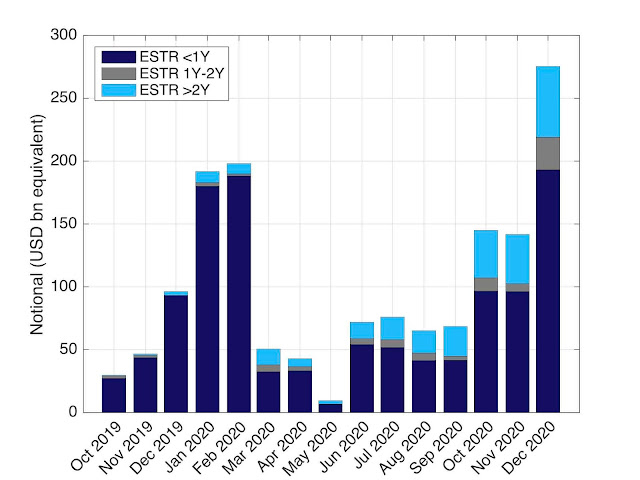
 This is a follow up on previous post on Where is ESTR? , Where is ESTR? (2) , Where is ESTR? (3) and Where is ESTR? (4) . It has been more than two months since the main CCPs have switch their PAI to ESTR in EUR and it should be the standard now. What do we see in the LCH data? Almost nothing! The monthly volume for ESTR OIS was less than 70 bn (USD equivalent), just  above 1/3 of what is was in January and February (see graph below). Not a very positive trend. The only positive trend, if I really have to find one, is that the volume for maturity above 2Y is increasing. With a notional of 23 bn, this is the highest since the start of ESTR.   This means a total volume for ESTR OIS of 774 bn since the start of the year. This is in contrast with the 62 trn in all OIS (EONIA and ESTR). ESTR-linked products are only 1.25% of all overnight-linked products (unchanged with respect to last month).   Were are only a little bit more than a week away from the EFFR to...

Where is ESTR? (4)

Image
This is a follow up on previous post on Where is ESTR? , Where is ESTR? (2) , and Where is ESTR? (3) . It has been more than a month that the main CCPs have switch their PAI to ESTR in EUR and it should be the standard now. What do we see in the LCH data? Almost nothing! The monthly volume for ESTR OIS was less than 72 bn (USD equivalent), just  above 1/3 of what is was in January and February (see graph below). Not a very positive trend. Figure 1: Monthly ESTR volume at LCH. This means a total volume for ESTR OIS of 705 bn since the start of the year. This is in contrast with the 56 trn in all OIS (EONIA and ESTR). ESTR-linked products are only 1.25% of all overnight-linked products. This lack of volume confirms my previous analysis that the change of collateral rate would have no impact on the market volume. With the fixed spread, there is no more incentive to switch now that there was two months ago. One can easily hedge the new discounting with the old rate, or the old d...

Where is ESTR? (3)

Image
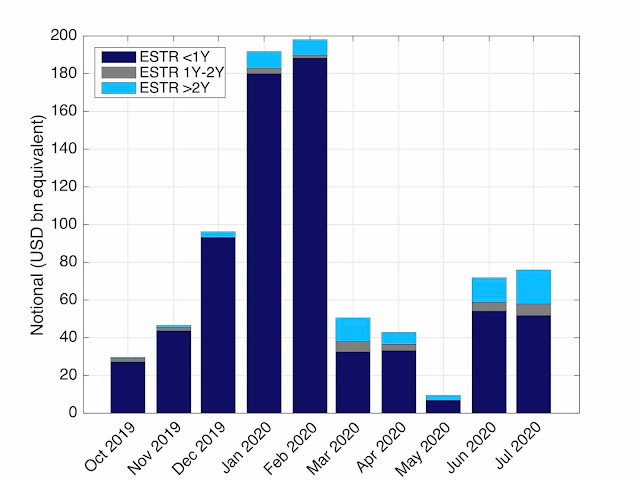
This is a follow up on previous post on Where is ESTR? and Where is ESTR? (2) In the mean time, the main CCPs have switch their PAI to ESTR in EUR and it should be the standard now. The July data includes one week in the new regime. What do we see in the LCH-cleared OTC data? Almost nothing! The monthly volume for ESTR OIS was 76 bn (USD equivalent), just  above 1/3 of what is was in January and February (see graph below). Not a very positive trend. Figure 1: Monthly ESTR volume at LCH. This means a total volume for ESTR OIS of 640 bn since the start of the year. This is in contrast with the 53 trn in all OIS (EONIA and ESTR). ESTR-linked products are only 1.2% of all overnight-linked products. The ISDA SwapsInfo weekly provides different figures, which are related to trade disclosed under US regulation only. In the last week, there were 20 new trades, this is around 20% of the number of trades since the beginning of the year. A big relative increase, but an increase from a...

Where is ESTR? (2)

Image
A couple of weeks ago, I asked "Where is ESTR?". That question resonated with a legal journal. The blog and a subsequent interview were the starting point of an article in Practice Insight - IFLR. Practice Insight is a " news service for lawyers, tracking how financial institutions are implementing Europe's capital market rules " (subscription required). Since then the clearing volume for June have been published by LCH . The volume was around 72 bn, i.e. barely a third of what is was in January and February. With a couple of weeks to go to the "big bang", one has to wonder what will happen then. The volume since the creation of ESTR is reported in the graph below. No upward trend is visible. Note that the EONIA = ESTR + 8.5 bps is true only to end of 2021. This means that the market data for OIS EONIA swaps with maturities beyond that data, i.e. OIS 2Y to 30Y, cannot be used to infer the market data for ESTR. I still wonder how CCPs will obtai...

Where is ESTR?

Image
EONIA is a derivative of ESTR and EONIA will not be published anymore as of January 2022. The new definition of EONIA, since October 2019, is ESTR + 8.5bps. EONIA does not add any financial advantage, but add legal risks. The fixed spread is often described as trivial. To my point of view it is not so trivial in practice as a 8.5 bps spread on the overnight rate is not the same as a 8.5 bps spread on the swap rates. There is a tradition of OIS with spreads, but the spread is on the final (compounded) rate, not on each fixing. The situation is different for LIBOR swaps, where there are composition with spreads (the famous straight, flat, spread exclusive and none, compounding methods). Similar issues are probably true with collateral. From a system perspective, ESTR + 8.5 bps is not the same as EONIA. As of 15 June, around 43,946 bn USD equivalent of EUR OIS have been cleared at LCH year-to-date. That correspond to roughly 8,000 bn a month. As end of may, there were 492.75 bn USD e...

Discounting big bang: CME auction process

CME has proposed a couple of webinar related to the collateral and discounting big bang planned for October 2020 . The general process is based on cash and discounting risk compensation. The discounting risk compensation involves the booking of EFFR-SOFR basis swaps in the accounts of all participants (members and clients). They clients can sell those basis swaps through an auction process (at their risk and cost). In this post, I look at some elements related to the auction as presented by CME in its recent webinars. Some elements of the discounting risk compensation Cash and discounting risk compensation based on the position and market levels as estimated by CME on Friday 16 October (EOD) Basis swaps obtained using DV01 of the portfolio for 6 tenors (2Y, 5Y, 10Y, 15Y, 20Y, 30Y), 6 trades are booked in all accounts with clearing date Monday 19 October Basis swap restore approximate pre-transition DV01. There are 3 sensitivity types (EFFR, SOFR, LIBOR). At most one can be restored. To...