Posts

Showing posts with the label Margin

V@R and minimal tick value

A Value-at-Risk (VaR) methodology is a technique to estimate the maximum loss at a given time horizon that is exceeded only at a certain probability level. Several methodologies are used to obtain those estimations and a lot of them are based on “scenarios”. They can be historical data inspired, stress tests or Monte Carlo. Those methodologies are often used to compute Initial Margin (IM) related to exchange traded portfolios. The instruments in exchange trades setup have standardized terms and conditions, including a “tick value” or “minimal increment” which indicates the precision of the price quotation mechanism. This is often one cent on prices and one basis point for interest rates. I have been involved in many VaR and IM methodologies over the past years: development, replication, validation. One question that I have been asked several times with different flavours is: How should the methodology account for tick value in the scenarios? Should the price generated by the scena...

FX forwards and regulatory IM

There are multiple discussions about bilateral IM for FX forwards and FX options, specially with category 5 coming into play next September. See for example the recent Risk article Margin rules snare FX options user (subscription required). Personally, I never understood why deliverable FX spot and FX forward were excluded from the framework, except perhaps that they had better lobbyists. I don't understand the " spirit " behind that rule. One propose workaround proposed to include some deliverable FX forwards is to use zero collar options to hedge the delta risk, in a way similar to what is done for IR swaps. There is another method that, to my knowledge, has not been publicly discussed before and which is to my taste nicer. And it does not involve options. Instead of a physically settled forward, one can trade a pair of forwards with one non-deliverable forward at the same date and rate one physically settled forward, the strike of which is set on the non-deliverable f...

Where is ESTR? (2)

Image
A couple of weeks ago, I asked "Where is ESTR?". That question resonated with a legal journal. The blog and a subsequent interview were the starting point of an article in Practice Insight - IFLR. Practice Insight is a " news service for lawyers, tracking how financial institutions are implementing Europe's capital market rules " (subscription required). Since then the clearing volume for June have been published by LCH . The volume was around 72 bn, i.e. barely a third of what is was in January and February. With a couple of weeks to go to the "big bang", one has to wonder what will happen then. The volume since the creation of ESTR is reported in the graph below. No upward trend is visible. Note that the EONIA = ESTR + 8.5 bps is true only to end of 2021. This means that the market data for OIS EONIA swaps with maturities beyond that data, i.e. OIS 2Y to 30Y, cannot be used to infer the market data for ESTR. I still wonder how CCPs will obtai...

Libor transition plans: delaying CCP discounting big-bang?

At a Quant Summit's panel last week, I was asked about the impact of Corona virus on LIBOR transition. Some of my comments were reported in Risk in the article Pandemic threatens Libor transition plans . I'm not a medical doctor (merely a doctor in mathematics) and I have no relevant advice on the pandemic itself. But if there are events that require special efforts and staff involvement (and the current situation certainly fit this description), is there some planned changes in the market that could be delayed? My immediate answer at the panel was UMR category 5 and LIBOR cessation. UMR is a long term project; the exact date is not important, what is important is the long term impact in term of counterparty risk in derivative; the approach selected can be agreed with or not, but certainly the impact is long term. The preparation impact is huge, but the financial impact on the implementation date will be 0. Delaying its start date by some months, or at least d...

Reducing CVA exposure using daily coupons

This could be classified as another episode of finance fiction! This blog starts with a couple of seemingly unrelated paragraphs and then continues in relating them in a way to improve the market infrastructure. One of the market developments in the last years has been the generalization of the Variation Margin (VM) and Initial Margin (IM). The goal of that framework is to reduce the credit risk in derivatives. A couple of years ago, the Quant of the Year award was related to a work on the subject of CVA exposure spikes in presence of Variation and Initial Margin. The underlying article, titled Does initial margin eliminate counterparty risk? (subscription required) by Leif Andersen, Michael Pykhtin and Alexander Sokol was published on Risk.Net in May 2017. In some sense, the article indicated that the margin framework, that is working very well in theory, fails in part in practice. The failure is due to the (large) payment of coupons that are taken into account by the VM only o...

SOFR PAI: One step less! One more arbitrage?

Image
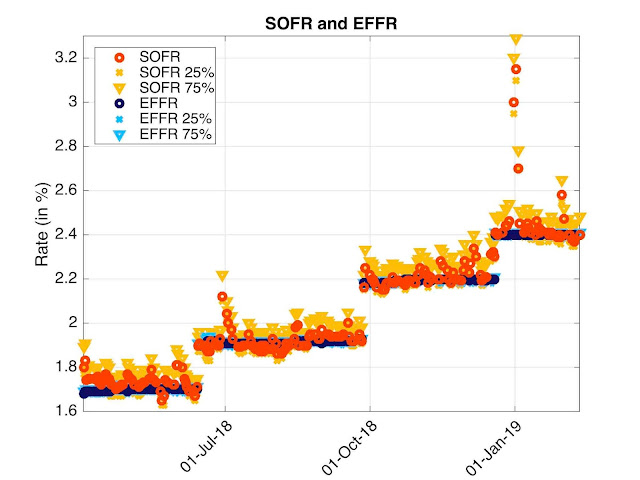
LCH has announced that it will merge two steps in the long five step process transition from EFFR to SOFR. The transition as described by the ARRC  included a step (Step 4) where CCP would offer the option to trade (USD) swaps with either EFFR or SOFR PAI (at the member choice). With the EFFR version available only to reduce the exiting exposure. The last step would have been to accept only SOFR collateralised trades and to transfer the remaining trades from EFFR to SOFR collateral. The announced decision that will take effect in 2020 (no precise date yet) will merge those two steps. LCH will use SOFR PAI for all new trades and at the same time transfer all existing (USD) trades from EFFR to SOFR PAI. My understanding is that the existing OIS indexed on EFFR will stay on EFFR for coupon computation purposes but move to SOFR for PAI (and the associated collateral valuation). A value transfer compensation (positive or negative) will be paid to all members and clients for this c...

It is not illegal to be smarter than your counterparties in a swap transaction

"It is not illegal to be smarter than your counterparties in a swap transaction, nor is it improper to understand a financial product better than the people who invented that product." Richard J. Sullivan United States Circuit Judge 30 November 2018 This is an interesting statement from the judgement in the United States in the case "CFTC versus Wilson and DRW" ( full text available here ). The text of the judgement provide a (surprisingly?) good explanation of derivatives market, including convexity effect on futures. The judgement relates to IDEX 3-month futures. Those futures are not traded anymore since 2011. The text includes consideration about variation margin, basis risk, PAI, convexity adjustments, and futures design. The background is a badly designed swap futures where some participants notice the bad design and its implications while others didn't. The marketing of the futures claimed that " IDEX IRS futures are designed to be economi...

Fallback, cash flows and OIS discounting

Image
In the IBOR fallback issue, there are different criteria we would like to impose in order to obtain a clean fallback. Among those criteria are the absence of value transfer and the coherence (IBOR is IBOR). The fallback procedures proposed in ISDA consultation rely on the replacement of each IBOR fixing by an RFR-linked rate plus an adjustment spread. The existence of CCP basis (and bilateral to CCP basis) which is potentially different between LIBOR products and OIS products leads to the following paradox: if we want to achieve the absence of value transfer, we need to select an adjustment spread that is different for the same IBOR and RFR depending on the clearing location, which is a violation of the coherence criterion. If we keep coherence, we have the same spread and consequently there is a value transfer. Where is the paradox coming from? I would say that it is coming from a misunderstanding of the OIS discounting formula. The formula is written as (see Formula 8.6, based ...

SOFR: multiple basis

A couple of weeks ago, CME announced that they cleared their first SOFR-linked swaps . The first trades where cleared by BNP Paribas, Credit Suisse, J.P. Morgan, Morgan Stanley and NatWest Markets. The total notional was USD 200 million without details on the type of swaps or their maturity. The main difference between the SOFR-linked swaps cleared at LCH and those cleared at CME is the Price Alignment Interest (PAI)/collateral rate. For LCH it is EFFR while for CME it is the SOFR itself. Both CCPs accept OIS (Fixed v SOFR) and basis (LIBOR v SOFR and EFFR v SOFR). Also LIBOR, EFFR and SOFR futures are traded. This means that now we have the full spectrum of legs types, PAI and adjustments: LIBOR leg with EFFR collateral (LCH, CME, bilateral) OIS-EFFR leg with EFFR collateral (LCH, CME, bilateral) OIS-SOFR leg with EFFR collateral (LCH, bilateral?) LIBOR leg with SOFR collateral (CME in basis swaps) OIS-EFFR leg with SOFR collateral (CME in basis swaps) OIS-SOFR leg w...

Benchmark and CSA

The following quotes are from a recent article in Risk titled " Esma: Eonia can be used in CSAs after 2020 ". Jakobus Feldkamp, senior policy officer for market integrity at the Paris-based European Securities and Markets Authority, tells Risk.net that CSAs will not be dragged into the BMR. “Esma agrees that it can be argued that a reference to Eonia in a bilateral agreement on an individual exchange of collateral under an OTC derivative is not strictly ‘use of a benchmark’ in the sense of the BMR,” says Feldkamp. The Article 3 (1) (7) of the European Benchmarks Regulation (BMR), refers to " determination of the amount payable under a financial instrument or a financial contract by referencing an index or a combination of indices ".  The regulation enters in full force on 1 January 2020. The question behind the interpretation of this sentence is to know if CSA referring to EONIA can still be legally used in Europe after that date. Not a minor issue certainly. ...

Variation margin in presence of trade cash flows

A couple of years ago, I have posted a blog called Continuous dividend v cash flows . With the generalisation of Variation Margin (VM) collateral, the derivative world is not driven anymore by discrete cash flows but by continuous dividend. Due to practical constraints, the VM is paid with a one day delay. This delay reduces significantly the effectiveness of the margin process as credit risk exposure reduction mechanism around the trade cash flow payments. The above blog presented an efficient and simple approach to bring back the effectiveness of the VM process even around trade flows dates. The approach is based on the usage of a forward valuation in the VM computation process. Since then, the research related to the spike of counterparty exposure has earned to its authors the Quant of the Year award. In the award winning paper ( Does initial margin eliminate counterparty risk? ), the authors have introduced my proposal in one of the conclusion paragraph. In its Guide on assessmen...

Alechinsky and Margin

Image
Today I visited an exposition on Pierre Alechinsky , a Belgian artist. Some of his works are visible at the MoMA . Among the frames, there was the poster of a previous artist exposition in New York titled   Margin and Center. Margins are following me everywhere now, even in art shows!

Game of Benchmarks: Season 1 - Episode 4: Transition and transition team.

Transition to a different world is difficult, more difficult than inventing a better world from scratch. In this episode, I’m looking at the transition. There are probably more questions than answers. But, as you know, In mathematics, the art of posing a question is more important than the art of solving one. Georg Cantor, 1867. Is transition important? Valuation of flow derivatives, and in particular Libor linked derivatives, and the associated collateral discounting framework are vanilla in name but certainly not simple if you have to implement them from first principles. The impact of features that were considered before the Great Financial Crisis (GFC) as “details” are nowadays very significant. You can not simply replace one benchmark by another and hope for the best. There are numerous items to take care of, like valuation framework, non linear effects, convexity adjustment, risk management strategies, liquidity, regulatory impacts, etc. I don’t know if, from a purel...

More EUR adjustments?

The ECB has decided to published a new unsecured overnight interest rate benchmark. The press released was posted on its website a couple of days ago. No name has been proposed yet for the new benchmark. This would be a new benchmark on top of the existing EONIA and STOXX GC Pooling Index. Those two benchmarks are already the underlying of some derivatives. It is expected that the new index, planned to be published by 2020, will also be used in some derivatives. That would mean three competing overnight benchmarks in EUR all of them with associated derivatives. That would means twelve (12) possible ON derivatives types. One type for each of the benchmarks used as underlying in combination with each of the benchmarks used for the computation of interest on the mandatory VM amounts, to which you have to add futures, which are equivalent to derivatives with a collateral rate of 0. And you have to add the potential difference in capital treatment for the settle-to-market feature . ...

Change of benchmarks and margin regulation

As discussed six months ago in my blogs ( here and here ), new benchmark indices mean new trades, new trades mean mandatory margin. If the interest rate benchmark indices like LIBOR, EURIBOR, SONIA, Fed Fund Effective or TOIS are modified or replaced, the contracts referencing them need to be adapted. Those contracts include the CSA referencing those indices as interest rate for cash collateral. Each contract need to be modified individually after agreement of each of the parties in the contract. If a contract is modified, it is considered as a new trade for the regulation related to mandatory margin. For all new trades, a mandatory daily Variation Margin (VM) applies for all counterparties and mandatory segregated Initial Margin (IM) applies for large derivative users, with more and more users falling in that category over time. The logic of the consequence of reorganizing the market infrastructure for benchmarks seems to have finally reached the "lawyers". A recent art...

Workshop on Margin

In the last years, I have reviewed the methodologies of the world largest OTC swap CCPs , read most of the recent related regulatory changes , research the impact of those changes on valuation and implemented most of them in libraries . Those exercises combined with my background in quantitative analysis and trading give me a unique perspective on the changes in the derivative market infrastructure . As part of the recent advisory engagements related to the above subjects, I ran several workshops on margins in Europe and in the US. Those workshops have been offered as one day or two days programs. Below are a short summary and the agenda of a typical workshop. The workshops are always tailored to the audience. Don't hesitate to contact me for more information or to request a similar workshop in-house. Summary One impact of the crisis has been the increase of the spread between different reference rates. Another impact has been the regulatory efforts to try to reduce the system...

Expanding blog's scope

Over the last year, I have used this blog to discuss questions related to the multi-curve framework in a large sense. I have decided to expand the blog's scope to "quantitative finance" in general. This will be reflected in the forthcoming blogs related to the mandatory bilateral margining and in the medium term with the announcement of a new book. Stay tuned.