Posts

Showing posts with the label Collateral

Published!

Image
My " Interest Rate Modelling in the Multi-curve Framework " book has finally been published! It took quite some time between finishing the writing in the first half of 2025 and the actual physical availability. Hopefully some of you will find some interest in the result. Training based on the book’s content will be proposed. It can be as in-house or public workshops. One of the public workshops is planned for 17 and 18 December. Don’t hesitate to contact me if you are interested. ISBN-13: 978-3-032-02684-2 Related posts: Multi-curve framework book: new edition in progress Multi-curve book's cover Multi-curve book's cover (2) Multi-curve book: About the Book Multi-curve framework book new edition: endorsement by Andrea Pallavicini Multi-curve framework book new edition: endorsement by Marco Bianchetti Multi-curve framework book new edition: endorsement by Damiano Brigo Book publication soon!

Negative Swap / Government Spread: A SOFR definition impact

Image
Negative government bond spreads have been a puzzle for some people for a long time. The question has been stated in some places as `` How can the banks borrow at a lower rate than the government? ''. I have already partially given my point of view about that issue in a blog 10 years ago . That was in the context of the LIBOR swaps, but it is still true in the SOFR case. Now I want to add some technical details for the SOFR OIS case. To some extent, I claim that the swap spread have to be negative! SOFR-OIS swap / government spreads In this analysis, I'm using the results of the multi-curve framework in a loose sense. I'm using expected values, without clarifying in which measure they are and extended the results to government bonds. The goal is to indicate that the ISDA definition of SOFR (introduced below) used in swaps may have an hidden impact on swap spreads. For this simplified approach, I'm presenting the impact only for zero-coupon bonds. The notation ...

X dominates the world

Image
For more than a decade, collateral discounting as been the de facto standard for derivative valuation. The central technical concept of this approach is the expectation under a currency — but not collateral mechanism — dependent measure. That measure is denoted in part of the literature. This is the notation I used in my Multi-Curve Framework with Collateral paper in 2023. This is the paper that developed the details of the “collateral square” valuation, when the collateral is is an asset that can itself be used into a repo to obtain cash. The generic formula in that latter case is (originally described in formula 13 in the above paper). The measure X appears in the expectation and is central to the approach, based on replication. It mathematics, it is traditional to add some marker (like a tilde or a bar) on some symbols to indicate another object similar or generated from the first one. One symbol that I like is the "check", which I called when I was lecturing in fren...

PLN benchmark transition

At the beginning of the week I participated to the "Benchmark Reform Congress" organized by CEETA in Warsaw (Poland). I discovered with interest the current situation in the Polish market with the strong push by the government to reform the interest rate benchmark and discontinue the use of WIBOR as the main benchmark by the beginning of 2023. The transition could be more difficult than in the LIBOR case as 6 months before the potential discontinuation date, the replacement benchmark has not been decided yet. The current overnight rate is POLONIA , published by the central bank; it is used for collateral remuneration but there is almost no OIS transactions. The local CCP KDPW is in theory clearing those instruments but there is currently no outstanding transactions (even if there were some a couple of years ago). The local players are discussing about potential new benchmarks. The current status is discussed in a long consulting paper published by GPW Benchmark: Transact...

FX forwards and regulatory IM

There are multiple discussions about bilateral IM for FX forwards and FX options, specially with category 5 coming into play next September. See for example the recent Risk article Margin rules snare FX options user (subscription required). Personally, I never understood why deliverable FX spot and FX forward were excluded from the framework, except perhaps that they had better lobbyists. I don't understand the " spirit " behind that rule. One propose workaround proposed to include some deliverable FX forwards is to use zero collar options to hedge the delta risk, in a way similar to what is done for IR swaps. There is another method that, to my knowledge, has not been publicly discussed before and which is to my taste nicer. And it does not involve options. Instead of a physically settled forward, one can trade a pair of forwards with one non-deliverable forward at the same date and rate one physically settled forward, the strike of which is set on the non-deliverable f...

Where is ESTR? (6) Where is SOFR?

Image
 A monthly follow-up on the "Where is ESTR?" posts.  Previous installments are Where is ESTR? , Where is ESTR? (2) , Where is ESTR? (3) , Where is ESTR? (4) and Where is ESTR? (5) . Increase in the volume, but still below the January and February levels. With the recent big bang from EFFR to SOFR for collateral (and discounting) at LCH and CME, how is the volume of SOFR related swaps doing? The volume has been increasing to reach more than 600 billions from a previous maximum of less than 400 billions the previous month. But October was the "big bang" month. Part of that volume may (or may not) be related to the auction and be a one-off increase. For USD-SOFR, I have also added (weekly) figures from ISDA Swap Info . Those figures are related only to transactions disclosed under US regulation, hence only a very partial (in both sense of the term) view of the figures. We see also an increase of SOFR volume (in yellow), but this has already decreased significantly s...

Where is ESTR? (5)

Image
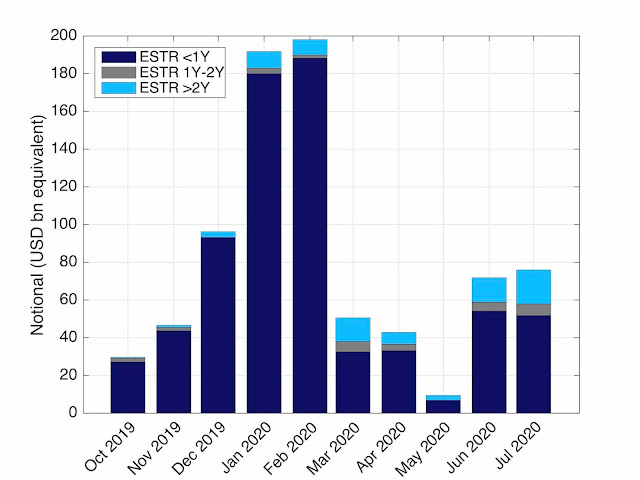
 This is a follow up on previous post on Where is ESTR? , Where is ESTR? (2) , Where is ESTR? (3) and Where is ESTR? (4) . It has been more than two months since the main CCPs have switch their PAI to ESTR in EUR and it should be the standard now. What do we see in the LCH data? Almost nothing! The monthly volume for ESTR OIS was less than 70 bn (USD equivalent), just  above 1/3 of what is was in January and February (see graph below). Not a very positive trend. The only positive trend, if I really have to find one, is that the volume for maturity above 2Y is increasing. With a notional of 23 bn, this is the highest since the start of ESTR.   This means a total volume for ESTR OIS of 774 bn since the start of the year. This is in contrast with the 62 trn in all OIS (EONIA and ESTR). ESTR-linked products are only 1.25% of all overnight-linked products (unchanged with respect to last month).   Were are only a little bit more than a week away from the EFFR to...

Where is ESTR? (4)

Image
This is a follow up on previous post on Where is ESTR? , Where is ESTR? (2) , and Where is ESTR? (3) . It has been more than a month that the main CCPs have switch their PAI to ESTR in EUR and it should be the standard now. What do we see in the LCH data? Almost nothing! The monthly volume for ESTR OIS was less than 72 bn (USD equivalent), just  above 1/3 of what is was in January and February (see graph below). Not a very positive trend. Figure 1: Monthly ESTR volume at LCH. This means a total volume for ESTR OIS of 705 bn since the start of the year. This is in contrast with the 56 trn in all OIS (EONIA and ESTR). ESTR-linked products are only 1.25% of all overnight-linked products. This lack of volume confirms my previous analysis that the change of collateral rate would have no impact on the market volume. With the fixed spread, there is no more incentive to switch now that there was two months ago. One can easily hedge the new discounting with the old rate, or the old d...

Where is ESTR? (3)

Image
This is a follow up on previous post on Where is ESTR? and Where is ESTR? (2) In the mean time, the main CCPs have switch their PAI to ESTR in EUR and it should be the standard now. The July data includes one week in the new regime. What do we see in the LCH-cleared OTC data? Almost nothing! The monthly volume for ESTR OIS was 76 bn (USD equivalent), just  above 1/3 of what is was in January and February (see graph below). Not a very positive trend. Figure 1: Monthly ESTR volume at LCH. This means a total volume for ESTR OIS of 640 bn since the start of the year. This is in contrast with the 53 trn in all OIS (EONIA and ESTR). ESTR-linked products are only 1.2% of all overnight-linked products. The ISDA SwapsInfo weekly provides different figures, which are related to trade disclosed under US regulation only. In the last week, there were 20 new trades, this is around 20% of the number of trades since the beginning of the year. A big relative increase, but an increase from a...

Discounting big bang: CME auction process

CME has proposed a couple of webinar related to the collateral and discounting big bang planned for October 2020 . The general process is based on cash and discounting risk compensation. The discounting risk compensation involves the booking of EFFR-SOFR basis swaps in the accounts of all participants (members and clients). They clients can sell those basis swaps through an auction process (at their risk and cost). In this post, I look at some elements related to the auction as presented by CME in its recent webinars. Some elements of the discounting risk compensation Cash and discounting risk compensation based on the position and market levels as estimated by CME on Friday 16 October (EOD) Basis swaps obtained using DV01 of the portfolio for 6 tenors (2Y, 5Y, 10Y, 15Y, 20Y, 30Y), 6 trades are booked in all accounts with clearing date Monday 19 October Basis swap restore approximate pre-transition DV01. There are 3 sensitivity types (EFFR, SOFR, LIBOR). At most one can be restored. To...

Convexity adjustment and discounting transition

The collateral transition from EFFR to SOFR as planned by LCH and CME in October 2020 generates an exotic convexity adjustment on USD-LIBOR payments with respect to the absence of collateral transition. This convexity adjustment is already incorporated in the cleared swap pricing. This adjustment leads to many questions. Some of them are What inverse convexity should be introduced to price OTC bilateral LIBOR swaps from cleared LIBOR swaps? Why was this adjustment not described by CCPs in their transition documents and no compensation for it was proposed? What is the order of magnitude of the convexity adjustment? In some sense, the third question may contain an answer for the first two. If the order of magnitude is negligible in practice, the answer to the first two question probably is: we don't care! I have submitted a paper proposing a (relatively simple) theoretical computation of the convexity adjustment and an estimate of the order of magnitude. The results indicate that the...

Compensation (and lack thereof): swaptions, protocol and swaps

Today is February 29th. I couldn't resits publishing something, at least for the date! Yesterday a new article related to rate transition hit Risk.Net. This time about the swaption compensation (subscription required). This is what I said about this compensation a week or so ago: "Personally I don’t believe that a market-wide compensation will be found, for the same reason that I believe that ISDA fallback protocol will not be generalised. Those value transfers create winners and losers; losers will sign, winners will not. If I know that I would have to compensate you for some swaptions and I have no legal obligation to do so, why would I even discuss a mechanism to do so?" The only argument for the compensation is some kind of peer pressure and credibility of the transition process. This roughly the summary of the Risk article. Let me compare this with my recent favorite subject: Cost of signing the LIBOR fallback protocol . In the swaption case, there is a ful...

Still confusion on OIS, overnight benchmark, collateral and discounting.

An important quant software provider proposes a webinar titled: Impact Analysis: The 2020 Clearing House Switch from OIS to SOFR Discounting It seems they don't understand what OIS is and what OIS discounting means. Please read my multi-curve book , Chapter 8 for the details. A meaningful title would be The 2020 Change in collateral rate at CCPs from EFFR to SOFR: discounting transition

Reducing CVA exposure using daily coupons

This could be classified as another episode of finance fiction! This blog starts with a couple of seemingly unrelated paragraphs and then continues in relating them in a way to improve the market infrastructure. One of the market developments in the last years has been the generalization of the Variation Margin (VM) and Initial Margin (IM). The goal of that framework is to reduce the credit risk in derivatives. A couple of years ago, the Quant of the Year award was related to a work on the subject of CVA exposure spikes in presence of Variation and Initial Margin. The underlying article, titled Does initial margin eliminate counterparty risk? (subscription required) by Leif Andersen, Michael Pykhtin and Alexander Sokol was published on Risk.Net in May 2017. In some sense, the article indicated that the margin framework, that is working very well in theory, fails in part in practice. The failure is due to the (large) payment of coupons that are taken into account by the VM only o...

Some European benchmark rules for critical benchmarks delayed by 2 years

The European Commission has announced in a press release that the EU institutions have decided to delay the entry into force of some regulation related to critical benchmarks and to third-country benchmarks by two years. Some rules have been delayed to 31 December 2021. This delay will in particular apply to EURIBOR, EONIA, LIBOR and STIBOR. For LIBOR it will apply irrespective of the Brexit result. Given the importance of this announcement, in particular for the derivatives collateralized at EONIA (with the mandatory clearing and UMR, this is almost all EUR derivatives), it is surprising that this announcement appears as a single paragraph in a press release on " Sustainable finance: Commission welcomes agreement on a new generation of low-carbon benchmarks ".  The paragraph of significant importance for the many trillion large EUR derivative markets is: Separately, the EU institutions also agreed to grant providers of “critical benchmarks” — interest rates such as ...

SOFR PAI: One step less! One more arbitrage?

Image
LCH has announced that it will merge two steps in the long five step process transition from EFFR to SOFR. The transition as described by the ARRC  included a step (Step 4) where CCP would offer the option to trade (USD) swaps with either EFFR or SOFR PAI (at the member choice). With the EFFR version available only to reduce the exiting exposure. The last step would have been to accept only SOFR collateralised trades and to transfer the remaining trades from EFFR to SOFR collateral. The announced decision that will take effect in 2020 (no precise date yet) will merge those two steps. LCH will use SOFR PAI for all new trades and at the same time transfer all existing (USD) trades from EFFR to SOFR PAI. My understanding is that the existing OIS indexed on EFFR will stay on EFFR for coupon computation purposes but move to SOFR for PAI (and the associated collateral valuation). A value transfer compensation (positive or negative) will be paid to all members and clients for this c...

It is not illegal to be smarter than your counterparties in a swap transaction

"It is not illegal to be smarter than your counterparties in a swap transaction, nor is it improper to understand a financial product better than the people who invented that product." Richard J. Sullivan United States Circuit Judge 30 November 2018 This is an interesting statement from the judgement in the United States in the case "CFTC versus Wilson and DRW" ( full text available here ). The text of the judgement provide a (surprisingly?) good explanation of derivatives market, including convexity effect on futures. The judgement relates to IDEX 3-month futures. Those futures are not traded anymore since 2011. The text includes consideration about variation margin, basis risk, PAI, convexity adjustments, and futures design. The background is a badly designed swap futures where some participants notice the bad design and its implications while others didn't. The marketing of the futures claimed that " IDEX IRS futures are designed to be economi...

SOFR: multiple basis

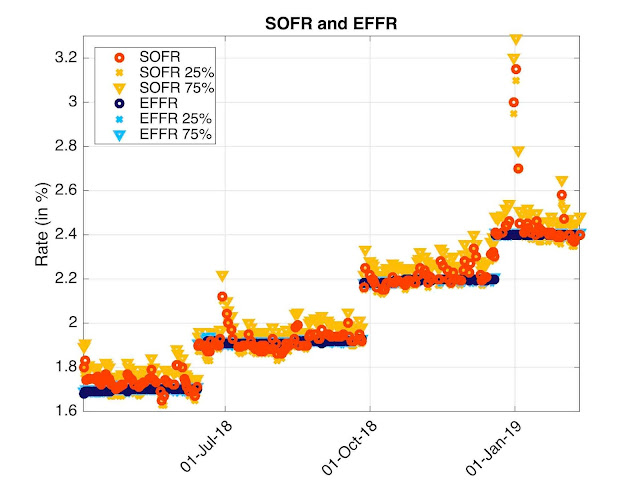
A couple of weeks ago, CME announced that they cleared their first SOFR-linked swaps . The first trades where cleared by BNP Paribas, Credit Suisse, J.P. Morgan, Morgan Stanley and NatWest Markets. The total notional was USD 200 million without details on the type of swaps or their maturity. The main difference between the SOFR-linked swaps cleared at LCH and those cleared at CME is the Price Alignment Interest (PAI)/collateral rate. For LCH it is EFFR while for CME it is the SOFR itself. Both CCPs accept OIS (Fixed v SOFR) and basis (LIBOR v SOFR and EFFR v SOFR). Also LIBOR, EFFR and SOFR futures are traded. This means that now we have the full spectrum of legs types, PAI and adjustments: LIBOR leg with EFFR collateral (LCH, CME, bilateral) OIS-EFFR leg with EFFR collateral (LCH, CME, bilateral) OIS-SOFR leg with EFFR collateral (LCH, bilateral?) LIBOR leg with SOFR collateral (CME in basis swaps) OIS-EFFR leg with SOFR collateral (CME in basis swaps) OIS-SOFR leg w...

Short note on long-term repos

The market infrastructure for interbank lending and derivatives has dramatically changed over the last ten years. The interbank lending is done now mainly on a secured basis. Derivatives are margined daily with variation margin guaranteeing the full present value of the trades. The world of interest rate benchmarks is also rapidly changing with the possible discontinuation of the IBOR benchmarks that have reigned on the benchmark kingdom over the last 30 years and the emergence of secured rate overnight benchmarks. All derivative users are now well aware of the difference between overnight-indexed swap (OIS) rates and term LIBOR deposit rates even if its discovery may have been sudden to some market participants in 2007. When we combined the secured term lending, the collateralised derivatives and the secured benchmark, what is left of the OIS-term deposit difference? This is the question I try to answer in a brief note now available on SSRN at https://ssrn.com/abstract=3258690 U...

EUR Overnight Benchmark - ESTER

The ECB has announced the result of the public consultation about the alternative EUR overnight benchmark. As expected, the ESTER rate, to be published by the same ECB, has been recommended by the Working Group on 13 September 2018 be used as the risk-free rate for the euro area. I still don't like the name risk-free rate (RFR). As described on the ECB ESTER page , " ESTER will reflect the wholesale euro unsecured overnight borrowing costs of euro area banks ". The rate is for unsecured and credit-risky transactions. The world is now divided in two groups, one where the reference overnight benchmarks are secured overnight rates - e.g. USD and CHF - and one where the reference overnight benchmarks are unsecured overnight rates - e.g. EUR and GBP. That can only increase the cross-currency basis and give more work to quants. On the secured rate front, we will soon have two competing term rates: OIS-like derivatives based on repo overnight rates and term repos. What is the l...