Posts

Would you pay 1,000,000,000 USD for public information?

Image
The IBOR fallback has been a hot topic over the last years. Will it soon also be an expensive topic? Don't worry, dear Reader, I do not plan to charge for my blogs ( multi-curve and muRisQ ). You will continue to get the most accurate and independent information available at the best price possible (0 USD). You may even find from time to time some open source code. No, my question is related to the adjusted RFRs and adjustment spreads. According to a recently published Bloomberg FAQ , " Yes, a license will be required from Bloomberg for usage of the ISDA fallback rates. " Those rates are based on publicly available information. In USD, this is based on SOFR , available on the Federal Bank of New York website and some past LIBOR rates. From those public rate, a public formula of interest rate composition, which has been public for more than 500 years (see for example Pratica della mercatura published around 1340), is used. I have myself published more recently (onl...
Fallback rule book: some comments

Some features of the IBOR Fallback Rate Adjustments Rule Book published recently by Bloomberg. Presented without order and with very little comments, just as the ideas comes when reading. I will add more features as I go through the document. The first comment was presented in a previous blog: Fallback and same day payment? I have a XXX-XIBOR-1M with effective date Friday 2020-03-27. The maturity date is Monday 2020-04-27. The "Accrual Start Date" for the composition has an offset of 2 business days and is Wednesday 2020-02-25, the "End Accrual Date" is 1 month later, i.e. Saturday 2020-04-25, adjusted to Monday 2020-04-27. The " two days shift " that was promised is actually a 0 day shift with respect to the payment date. Example 1M-IBOR swap over 5-month period: 2020-03-26 to 2020-08-26. The standard accrual periods for the coupons payments are on dates 2020-03-26, 2020-04-27, 2020-05-26, 2020-07-26, 2020-07-27, and 2020-08-26. The ac...

Fallback and same day payment?

Reading the Bloomberg IBOR Fallback Rate Adjustments Rule Book just published. I'm trying to understand the period for RFR composition. It looks that the period is based on the LIBOR tenor. It is not the " calculation period " that was used, but never defined, in the consultations. Do I misunderstand something or there is something strange with the " two days shift " and the " two day shift " may actually be a 0 day shift with respect to the payment date? Do we end up having to pay same day in some cases? My understanding of the dates and offsets leads to the following example, using the coming Monday as an example. I have a XXX-XIBOR-1M with effective date Friday 2020-03-27. The maturity date is Monday 2020-04-27. The "Accrual Start Date" for the composition has an offset of 2 business days and is Wednesday 2020-02-25, the "End Accrual Date" is 1 month later, i.e. Saturday 2020-04-25, adjusted to Monday 2020-04-27. I'm...

CCP EUR discounting big-bang delayed ... by 1 month

For once, one my recommendations related to benchmark transition was followed ... partly. My recommandation was to postpone the big bang sine die , up to the time when all the consequences (e.g. swaptions) are fully under control and preferable to cancel the big-bang all together. To my opinion, the more sensible choice is a paced transition. The delay to 27 July is short of the September date proposed by the ECB-led working group in a consultation and very short of my "sine die" proposal. The delay is reported in Risk.net: Clearing houses postpone euro discounting switch to July (subscription required). This delay proves, if needed, that the arguments put forward by the CCPs and discussed in my previous blog CCP Discounting big bang: delaying or not? were nothing more that nonsense. On the other side, the discussion about why such a big bang is even necessary is still open. A trader speaking to Risk indicated that any delay would be “ a disaster ” for swaptions, but ...

Pre-cessation it will be :(

ISDA has announced the preliminary results of the consultation on pre-cessation trigger for LIBOR fallbacks . The results are: The initial results indicate a significant majority of respondents are in favor of including both pre-cessation and permanent cessation fallbacks as standard language in the amended 2006 ISDA Definitions for LIBOR and in a single protocol for including the updated definitions in legacy trades. This goes against my opinion on the question as expressed in a previous blog . This make my cautionary tale about signing the protocol even more valuable. This choice will increase the discrepancy between products, e.g. legacy and new trades. My analysis of that issue was later corroborated by the ARRC . More than ever, watch out for value transfer! Note that the consultation was refereeing only to LIBOR (not IBOR in general) and to the FCA (not to regulators in general). We will see if the final wording includes those terms or if (another) workaround is n...

CCP Discounting big bang: delaying or not?

In a recent opinion , following to the QuantSummit panel where I was asked a similar question, I indicated that one of the first element I would like to see delayed due to the current crisis and the related emergencies is the CCP discounting big bang. First, the big bang was not necessary. The original idea, as described in the ARRC paced transition plan, was to have a period with two parallel PAI world and transfer smoothly and over time between them. Later it was decided on the EUR and USD sides to skipped the "paced" part and do a big bang, at least at the CCP level. The big bang make the transition easier for CCPs. One day they have one approach, the next day (actually 3 days later, as this is done on a week-end) they have another approach. At any moment, they have to deal with only one discounting curve. This is not the case for the users. They have the cleared trade to deal with, so the complexity for them is at least as high than for the CCPs, but also numerous bil...

Spread, transition period, cliff-effect and manipulation

Image
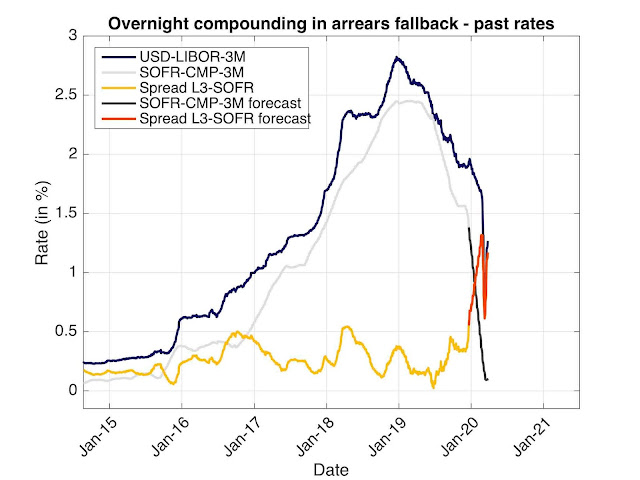
The recent volatility and blowout of the LIBOR/overnight-linked spread have reopened the question about the fallback transition period for the adjustment spread. In this post, I will reiterate my opinion on the issue, already expressed in a couple of notes (for example Section 4.2 in A Quant Perspective on IBOR Fallback Consultation Results , January 2019 ), blogs and panels. The current spread level and its evolution over the last 5 years is displayed in the graph below. This is the spread between the forward looking USD-LIBOR-3M and the backward looking SOFR compounded over the same period. The data points are aligned on the fixing date of LIBOR. The graph should end on 2019-12-20 as this is the last date for which we have the full compounded SOFR data. This is represented in yellow. Nevertheless we have LIBOR data for an extra 3 months and we have some ideas of where the SOFR could be fixing over that period. The red part of the graph represents that estimation build from known L...